
Sub-Total: $0.00
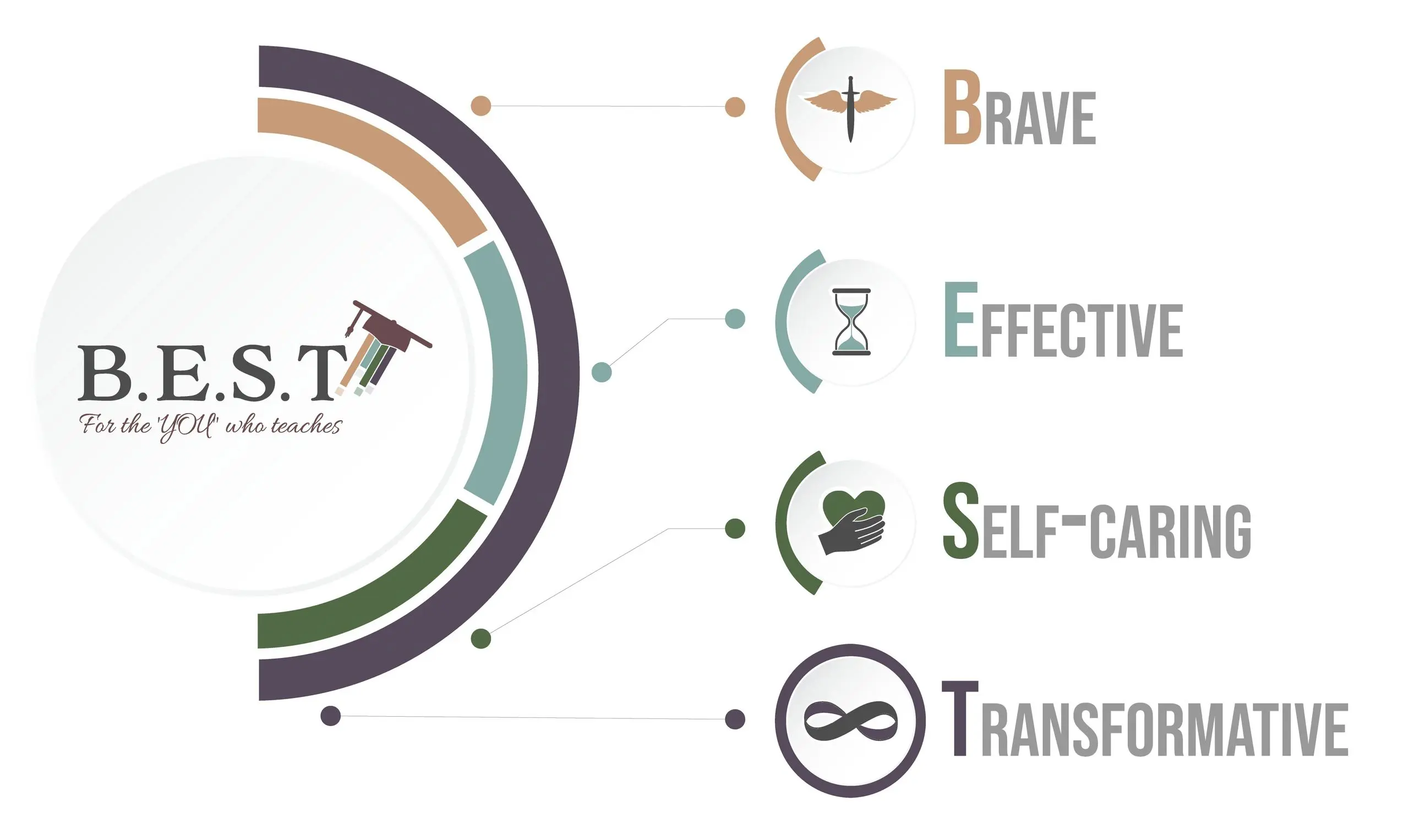
Welcome to this third posting in my five-part series about The B.E.S.T. Formula.
If this is your first time reading about The B.E.S.T. Formula, I highly recommend backing up a little and reading these postings first:
The B.E.S.T. Formula: What is it?
The B.E.S.T. Formula: B is for Brave
If you’re ready for the Effective part of the formula, let’s dive in.
Whenever I pass a teacher in the hallway, I usually toss out the familiar phrase, “How’s it going?” Sometimes, my question is a simple greeting, like “Hey there, I see you, have a good day.” I don’t expect a response, especially if that teacher is marching toward the bathroom with an urgent look, or marching toward the coffee maker in the teacher’s lounge, cup in hand. Take it from a seasoned veteran teacher: you do NOT want to get in their way.
But I also watch for more casual opportunities, like when a teacher is emerging from the bathroom or the staff lounge with their Cuppa-Joe and a smile on their face. In those moments, the question of “How’s it going,” asked in an authentically curious manner, can really make a teacher’s day.
Most of the time, my colleagues sigh and say things like, “I’m having a hard time keeping track of everything.” Or “I’m swamped/overwhelmed.” Or “I just don’t know if I’m cut out for this job. The kids aren’t … (fill in the blank).”
Their smile dims slightly, and I sometimes feel bad for ruining their moment of bliss. But, lately, I’ve been trying a new approach. Instead of sighing along, and agreeing that there’s a sh*t-load of things to do every day and it’s just so typical that we’re pulled in so many directions but we just have to suck it up. etc., I ask for more details:
- “What kinds of things are you trying to track?”
- “If you could label a row of buckets for every direction you’re being pulled, what would you write?”
Those questions tend to generate a livelier outpouring of hopes and dreams.
I cannot list everything teachers say; that would fill a bazillion buckets. But, in general, what comes through is that teachers are looking for a system to track the countless tasks that come with the territory of teaching: making copies, making phone calls, finding pens and pencils, and finding case managers who can help them understand how to more effectively work with a student who is floundering. Teachers want to feel like they are making progress in a profession that has dozens of interruptions and, like a whirligig ride at a carnival, goes up and down and swirls around, with nary an off-ramp in sight. In a word, they want to be more EFFECTIVE.
When I got the “download” of The B.E.S.T. Formula, the letter “e” wasn’t “efficient,” it was Effective.
Was there a difference? I pulled out my phone and did a quick search.
As it turns out, there is. I learned that “efficient” and “effective” both mean “capable of producing a result,” but:
Effective means producing a result that is wanted.
Efficient means capable of producing desired results without wasting materials, time, or energy. [1]
The more I thought about it, the word Effective seemed more comprehensive. When a teacher is effective, she is making good use of time and resources AND she is making a positive impact. Effective feels bigger than simply being efficient. It feels more meaningful in the long run.
Think about a teacher who had a positive impact on your life. That teacher might have been efficient with time and resources (or maybe not), but the reason they impacted your life is because they were effective in connecting with you, and perhaps connecting you to the content of their craft.
Is there a tool to help a teacher become more effective?
As it turns out, there is. It’s called the Full Focus Planner. I say more about this tool on my website. But if you and I had only a few minutes to visit between the bathroom (or the staff lounge) and your classroom, here’s what I would say.

1. The Full Focus Planner helps you avoid dropping tasks. There are pages for quickly logging your “To Do’s,” whether personal or professional (even sticky notes). And, every week, you are guided through reviewing those notes to change them, delegate them, reschedule them, or eliminate them altogether. It’s Teaching Nirvana. What teacher doesn’t love crossing things off a list?!
2. The Full Focus Planner teaches you how to become more realistic with your plans. You improve your capacity to identify and prioritize desires, dreams, and resources, whether your focus is lesson planning, meetings with parents or colleagues, or making improvements in your personal life and relationships. Being more realistic means not feeling depleted when things don’t go as planned. You “pivot” instead, and set up your next step. You get yourself cued up to do the next right thing for you and those in your immediate sphere of influence.
3. The Full Focus Planner helps you grow in resiliency. In as little as a few days with the planner, you find that you are able to facilitate sudden changes in your schedule, like when a kid thinks it would be funny to pull the fire alarm, or the copy machine jams and ruins an activity for extended practice. (As an aside, I’ve always thought that copy machine maintenance ought to be included in all certification programs.)
I can hear you saying, “I don’t have time to write everything down! Can’t you see that I barely have time to pee or get more coffee, which makes me have to … well, whatever …
But I have a couple questions for you: Don’t you already write things down? Don’t you already have a hundred sticky notes covering your computer, your desktop, and your current teaching planner?
I totally understand. I once had to write a sticky note to remind me to write a sticky note. I’ve emailed myself to write a note on a sticky so I wouldn’t forget to look at a sticky. You get the idea. That is a freakin’ waste of time. In a word, INEFFICIENT. Which means INEFFECTIVE.
If you already have a system for keeping track of things, that’s great. But does that system help you be more intentional in the long run, more strategic with your time every day, week, month, and throughout the year?
Does your system put a smile on your face, because you know you’ve accounted for everything you can, and are living the life you’re meant to live, personally and professionally?
If not, I encourage you to try this one system. Try a Full Focus Planner. It may seem like a bit of an investment, especially when the planner covers only three months (they are designed for quarters in the year). But this is the BEST investment (pun intended) you’ll ever make, and I will give you a free coaching session via Zoom. If you live in Seattle and want to meet in person, I’ll even treat you to a coffee or tea!
Try it for one quarter: three months. Use it alongside your current lesson planner and any digital appointment/reminder system you like. The Full Focus Planner doesn’t have to replace those approaches to organizing your life. But it will help you DESIGN the life you want as an educator, spouse, parent, or weekend Pickleball Ninja.
If, after three months, you want to go back to your older systems, I can help you transfer the skills you’ve learned form the Full Focus Planner, and keep what works for you. That is perfectly fine. If you want to reinvest in a Full Focus Planner in the future, that works too!

Click this link for more information about the Full Focus Planner: https://genetsimone.com/full-focus-planner
Next week, I examine the third key ingredient in The B.E.S.T. Formula: “S is for Self-Care” …
If you are reading this post in Facebook, you will find it there! If you want to make sure to get that post, and others about the teaching life, sign up here.
See you in the halls!
[1] Source: How to Use Effective and Efficient | Britanica Dictionary