
Sub-Total: $0.00

IF YOU’RE ONE OF THE MILLIONS OF TEACHERS whose lives have been upended by COVID-19 school closures, this image of “screens” sums up the first thing you see in the morning, and it’s likely the last thing you see before your head sags into your pillow at night.
Remember when we used to say to kids that they needed to limit their screen time or else their brain would fry? Well, we’re hardly in a position to argue about that anymore. Teachers at all levels are now spending a crazy amount of time in front of screens these days: laptops, desktops, iPads, iPhones, Androids.
Then, after a long day, we may plop onto the couch to catch up on the latest news or watch Netflix—anything to entertain what’s left of our brain.
These screens are a blessing for sure, allowing us to interface with our students, colleagues, and families in order to deliver some semblance of content and togetherness during this unprecedented time.
BUT: We’re starting to feel the energy drain of that intense work. As I write this, I realize that I’ve been on my laptop for over 6 hours today, planning with other teachers, researching videos for my class, initiating and answering dozens of emails, scheduling more meetings on Zoom or Microsoft Teams … and now I’m going to have a Zoom call with family tonight!
At one point today, I realized that I was simultaneously trying to operate three devices at the same time, and still feeling like I wasn’t getting anything done. No wonder my eyes are burning! And my neck is sore, and my shoulders are in dire need of a massage that won’t be available for probably 6-18 more months.
This new physical-distance-online-reality may extend through summer and into the fall. We don’t really know when change will occur or what it will look like. And our new screen reality is impacting teachers whose children are also on screens.
Like everything-technology, the mental, emotional, and physical impact is exponential. And it isn’t sustainable.
But teachers can’t necessarily limit their screen time without neglecting important aspects of their work. Even when we take short breaks, there is a constant pull to go back at it.
Our breaks aren’t as relaxing as they could be, due to the swirl of knowing that emails continue to pile up in our In Box and our lessons aren’t going to write themselves! And ~ even though well-intentioned ~ our school leaders and district personnel continue to throw more and more webinars and technology training our way. I’m spending more time online, learning how to be online! And that doesn’t reduce my stress.
For every webinar offered, time and energy are needed to read the description and decide whether it’s something that’s critical to my teaching or just another “shiny penny” that includes even more hyperlinks.
IT’S. A. LOT.
BUT HERE’S THE GOOD NEWS. There’s a simple way to pivot away from this stressful buildup.
All you do is balance out your ions.
.jpg/:/cr=t:0%25,l:0%25,w:100%25,h:100%25/rs=w:1280)
WHAT THE HECK IS AN ION?
An ion is an atom or molecule with a net electric charge due to the loss or gain of one or more electrons.
I don’t know much about the science of ions, so stay with me here. But I do know that there are both positive and negative ions. I will tackle the positive ones first.
Contrary to the name (positive), which would normally mean something good for you, positive ions are NOT good for you. They are “charged” particles in your surroundings that cause free-radical damage in your body.
They can compromise your immune system, bringing on headaches, dizziness, fatigue, respiratory troubles, allergies, irritability, anxiety, and depression, to name a few.
Positive ions produce STRESS on our bodies, in other words, and that is not a good thing if it occurs every day. There is a cumulative effect that can lead to some dangerous health problems.
Stress also shuts down our prefrontal cortex, and then we can’t think. We become dull, dumb, unable to absorb information. DUH.
Where do positive ions come from? What’s generating them? Basically, any electrical or WiFi appliance or device in your space.
· TV sets and computer monitors
· Microwaves and cell phones
· Modems and routers
· Baby monitors
The electromagnetic field around each of these “hotspots” varies from one to the next, but their influence can extend for a number of feet from their original source, and even through walls.
Yikes! How do we counteract all of free-radical-damaging “positive” ions? They’re EVERYWHERE!
You’ll be happy to hear that the antidote is simple: Get yourself some NEGATIVE ions. (Yes, I know the terminology is counter-intuitive.)
NEGATIVE IONS BALANCE OUT THE POSITIVE IONS. They produce biochemical reactions in our bloodstream that lead to increased production and release of the “happy mood” chemical, serotonin, which in turn helps to alleviate depression, reduce stress and boost daytime energy.
Negative ions help you with detoxing a stressed body, increase your alertness and concentration. With exposure to more sources of negative ions, you will improve your breathing, have a calmer pulse rate, sounder sleep, and strengthened immune system ~ which is a critically important thing right now!
In short, negative ions bring your body back into balance so the organs that keep you alive can do what they do.
Bruce Lipton, cell biologist and author of many books and videos on human biology and health, says that we actually carry viruses and parasites (ick) and all kinds of bacteria in our bodies all of the time. But sustained low-level stress ~ such as that which we experience from exposure to positive ions (i.e., too much screen time) ~ makes our cells shut down. And that leads to illness.
Sitting in front of computer screens, tablets, etc., is just making us sicker.
Okay, enough already with the bad news, where can I find me some negative ions?!
Not surprising, the best places to counteract the unhealthy effects of man-made materials are in our natural environment. Just looking at this photo of the forest ought to make you automatically take a deep breath, right? Go ahead and do that. Smell the pine needles. Hear the soft rush of air through the trees.
If forests aren’t your thing, how about the beach?
Aaaaah. Yes.
“But this darned shelter-in-place is preventing me from traveling!” you say. Sigh.
I KNOW. But there ARE some free and low-cost things you can do to increase your negative ion exposure, even if a trip to the mountains or the Bahamas is out of reach.
WALKING BAREFOOT ON THE EARTH. I kid you not, walking barefoot on the earth, or sitting with your bare feet on the grass or sand, is the simplest way to restore balance to your body and release the positive ions that are grabbing a hold of you in a bad way.
Just 15 minutes with your bare feet on a porous dirt, sand, or grass can have an enormously healthy impact on the size and shape of your blood cells. And when your blood cells are plumper, they carry more oxygen to your cells. It’s that simple!
By the way, this is one reason it’s counter-productive to walk on a beach while wearing rubber-bottomed shoes. The rubber prevents your body’s absorption of the negative ions. So the next time you are outside, slip off those shoes!
Check out this image of blood cells before and after walking on the earth barefoot (referred to as “grounding” or “earthing”).
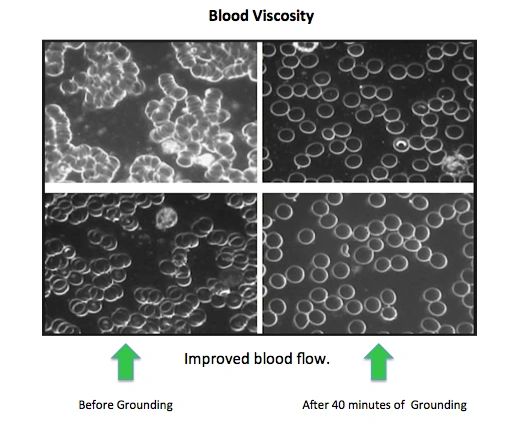
The cells on the right are obviously more open and capable of carrying oxygen and nutrients to the body. (Source)
Seriously: Schedule time to treat your body to this incredibly free adventure in healing. Right after reading this, go outside and sit or walk barefoot for 15 minutes.
FRESH AIR, MOVING WATER. Nothing relieves stress like fresh air, especially if you live near a creek, ocean, or river. Remember that ions are molecules that have gained or lost an electrical charge. They are created in nature as air molecules break apart due to sunlight, radiation, and moving air and water. It’s lovely to be outside and near these sources of energy! If you can’t access those conditions so easily, consider purchasing a small indoor or outdoor fountain.
PLANTS. Need to stay inside? The best plants for emitting a lot of happy and healthy energy are philodendrons, spider plants, aloe vera, peace lilies, and potted ivy. I totally LOVE philodendrons, because they can be snipped and regrown quickly, and they seem to survive those of us who don’t have much of a green thumb.”
HIMALAYAN SALT LAMPS. These lamps are known to counteract the electronic vibrations and excessive positive ions caused by electronic devices in your home. Make sure the lamp is heated, as the heated salt attracts and absorbs water in the air; that water evaporates, and the positively charged ions of sodium and the negatively charged ions of chloride become neutral and are released into your environment, thus reducing pollutants, irritants and allergens from the air.
And there are many more materials that will help you balance out—even eliminate—all of the “negative” effects of positive ions.
I don’t want to add to your screen time, but I do recommend checking out this website or at least bookmarking it for later! 8 Ways to Expose Yourself to Earth’s Negative Healing Ions
SO WHAT ARE YOU WAITING FOR?
Give yourself permission to go outside and breathe in the fresh air. Place your bare feet on the grass. In a moment, you can experience a shift in your mood and energy levels. In fifteen minutes, you can go from feeling drained to feeling sustained and ready to take up the next round of teaching online. Just don’t wear your headphones and listen to the news.
THIS IS TEACHING FROM THE INSIDE-OUT.
SOURCES
https://www.edweek.org/ew/section/multimedia/map-coronavirus-and-school-closures.html
How Stress Affects Your Life Today – Dr. Bruce Lipton – Best Motivational Video 2020 how to teach online without going crazy